A recent inquiry from Belgium highlights a specific requirement that is increasingly important for WPC decking projects: large quantities of pure white WPC decking with a clearly defined color standard. The buyer specifically emphasized that the decking boards must be truly white rather than off-white or cream-colored. This distinction may appear simple, but it can have a major impact on project appearance, product selection, quality control, and supplier evaluation. For distributors, decking installers, construction companies, landscape contractors, and project buyers in Belgium and other European markets, sourcing white composite decking in large quantities requires more than simply choosing a product described as “white.” The actual shade, production consistency, surface finish, weathering performance, dimensions, and packaging all need to be considered before placing a bulk order.
Table of Contents
Why Pure White WPC Decking Requires Special Attention
White is one of the most visually demanding colors for outdoor building materials. Small differences in color can become obvious when multiple boards are installed next to one another. A board that appears white in a product photograph may look slightly ivory, greyish, beige, or cream under natural daylight.
This is particularly important when a customer has specifically requested pure white decking. In such projects, an off-white product cannot simply be considered an acceptable alternative. The finished deck may need to match a modern architectural design, white exterior walls, railing systems, garden structures, commercial buildings, or other outdoor elements.
For this reason, buyers should communicate the color requirement clearly before production. Instead of using only a general description such as “white WPC decking,” it is better to specify that the required product should be visually pure white and should not have a cream, beige, or off-white appearance.
For large orders, the supplier should also maintain consistent color control throughout production. This helps reduce visible differences between production batches and provides a more uniform appearance across the completed installation.
What Makes White WPC Decking Different from Standard Colors?
WPC decking is produced by combining wood fibers or other lignocellulosic materials with polymer materials and additives. The formulation, pigments, surface treatment, extrusion conditions, and finishing process all influence the final appearance of the decking board.
Dark brown, grey, and wood-effect colors can sometimes conceal small variations more effectively because their visual characteristics are relatively complex. Pure white surfaces, however, tend to reveal even minor differences.
The production process therefore needs to be carefully controlled when a customer requires a consistent white finish. Factors such as raw material ratios, pigment dispersion, extrusion temperature, cooling conditions, surface treatment, and batch management can affect the final result.
For large-volume projects, buyers should ask whether the supplier can provide a physical color sample before mass production. This gives the buyer an opportunity to compare the sample with the intended architectural design or reference color.
Large-Quantity Supply for Belgian WPC Decking Projects
A large-volume order requires a different procurement approach from a small residential purchase. When hundreds or thousands of decking boards are required, product availability, production capacity, lead time, packaging, and shipping arrangements become important considerations.
For a Belgian buyer purchasing pure white WPC decking in large quantities, the supplier should be able to confirm several key points before an order is finalized.
First, the supplier should confirm whether the requested white color is available as a standard production color or requires customized production. If the color is customized, the supplier should clarify the minimum order quantity, sample approval process, production schedule, and color-control procedure.
Second, the supplier should provide accurate board specifications. These may include board width, thickness, length, weight per meter, profile structure, surface finish, and installation method. Different projects may require different profiles depending on structural requirements and design preferences.
Third, packaging should be suitable for international transportation. Decking boards must be protected against impact, moisture, contamination, and unnecessary surface damage during handling and shipping.
Why Color Consistency Matters in Bulk Orders
One of the biggest risks when purchasing large quantities of white decking is inconsistent color between batches. A project may receive several containers or production batches over a period of time. If the white tone varies significantly, the difference can become visible after installation.
This is why professional buyers should discuss batch consistency with the manufacturer before confirming the order.
A practical approach is to approve a physical sample or master sample before mass production. The approved sample can then be used as the reference for production quality control. If the order is exceptionally large or will be delivered in multiple shipments, the buyer can also discuss batch management with the supplier.
For distributors, maintaining consistent color is especially important because the same product may later be supplied to different construction projects. A stable production standard makes inventory management easier and reduces the risk of customer complaints.
Outdoor Performance of Pure White Composite Decking
Color is only one part of the purchasing decision. WPC decking is primarily an outdoor building material, so buyers should also consider how the boards perform under changing weather conditions.
Belgium has a relatively humid climate with frequent rainfall and changing temperatures throughout the year. Decking used in gardens, balconies, terraces, commercial outdoor areas, and other exposed environments needs to tolerate regular exposure to moisture and temperature fluctuations.
Important product characteristics can include resistance to moisture, dimensional stability, surface durability, resistance to cracking or splitting, and ease of maintenance.
A white surface also requires attention to appearance after outdoor exposure. Dirt, dust, algae, leaves, and other outdoor contaminants may be more visible on white decking than on darker colors. Therefore, the surface structure and cleaning requirements should be evaluated before purchasing.
For commercial or residential projects where appearance is a priority, buyers should understand the supplier’s recommended cleaning and maintenance procedures.
Surface Finish and Design Options
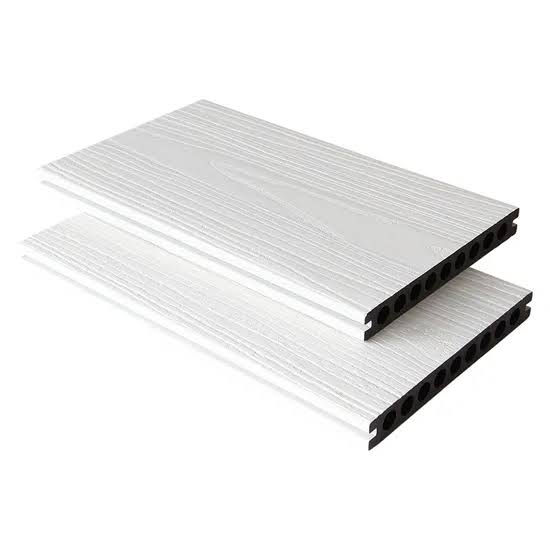
Pure white does not necessarily mean that every white decking board will have the same visual effect. The surface finish can significantly influence the appearance of the installed deck.
A smooth surface can create a clean and contemporary architectural appearance, while a wood-grain or brushed texture can provide a more natural outdoor look. Some projects may prefer a minimalist modern finish, while others may require a textured surface to complement gardens, terraces, or residential architecture.
The profile design also affects installation and appearance. Hollow profiles can reduce material weight, while solid or reinforced structures may be selected for specific load requirements. Depending on the application, concealed fastening systems can provide a cleaner appearance because fewer screws or fixing points are visible from above.
When ordering large quantities, it is advisable to confirm the complete product configuration rather than focusing only on the color.
How to Source Pure White WPC Decking in Bulk
A reliable sourcing process can help international buyers avoid unnecessary production and shipping problems.
The first step is to provide the supplier with the exact required color. If the buyer has a reference sample, color card, photograph, or project specification, this information can help the manufacturer understand the requirement more accurately.
The second step is to provide the estimated quantity. Large-volume orders should ideally include the approximate number of boards, required lengths, preferred profile, and expected delivery schedule.
The third step is sample confirmation. A physical sample is particularly valuable when the requirement is “truly white.” Digital photographs cannot always reproduce color accurately because lighting, camera settings, screens, and image processing can change the perceived shade.
The fourth step is technical confirmation. Buyers should verify dimensions, tolerance, surface finish, material composition, installation accessories, packaging, and loading method.
Finally, the supplier should confirm production capacity and lead time. For a large project, production planning should take place before the purchase order is issued to ensure the required quantity can be produced within the project’s schedule.
Pure White WPC Decking for Modern Outdoor Architecture
The demand for white outdoor materials is closely connected with contemporary architectural design. White decking can create a clean visual contrast with green landscaping, dark window frames, stone walls, swimming pools, and modern outdoor furniture.
It can also help create a visually consistent outdoor space when the building itself uses white or light-colored architectural materials.
Potential applications include residential terraces, balconies, rooftop areas, pool surrounds, garden platforms, hospitality projects, commercial terraces, outdoor restaurants, and landscape installations.
For large architectural projects, color accuracy becomes part of the overall design specification rather than simply a product preference. This makes supplier communication particularly important.
Questions Buyers Should Ask Before Ordering
Before placing a bulk order, a buyer can ask the manufacturer:
- Is the product genuinely pure white rather than off-white?
- Can you provide a physical sample for color approval?
- Can the same color be maintained throughout a large production order?
- What board dimensions and profiles are available?
- Is the required length available for bulk production?
- What is the minimum order quantity for white production?
- What is the expected production lead time?
- How are the boards packaged for international transportation?
- What installation accessories are available?
- What cleaning and maintenance procedures are recommended?
- Can production be arranged according to a project-specific specification?
These questions can help buyers compare suppliers based on actual manufacturing capability rather than product photographs alone.
Conclusion
The Belgian inquiry for large quantities of pure white WPC decking demonstrates why color specifications should be treated as an important technical requirement in international WPC procurement. When a buyer needs truly white boards rather than off-white or cream-colored alternatives, the supplier must pay close attention to raw materials, pigmentation, extrusion, surface finishing, and batch consistency.
For large projects, the purchasing process should begin with clear specifications, a physical sample, and confirmation of production capacity. Dimensions, profile structure, surface finish, outdoor performance, packaging, and delivery arrangements should also be confirmed before mass production.
For buyers in Belgium and other European markets, choosing a manufacturer capable of handling customized color requirements and large-volume production can make the procurement process more predictable. Most importantly, the final product should meet the customer’s visual expectation: a clean, consistent, genuinely white decking surface suitable for modern outdoor applications.