For fencing distributors and installation companies in Poland and Germany, selecting the right WPC fence boards is not simply a matter of comparing product prices. A full-container purchase requires careful consideration of board structure, thickness, dimensions, colours, loading efficiency, aluminium accessories, outdoor performance, and factory production capability. For a company serving both residential and commercial fencing markets, the consistency of every shipment can directly affect installation efficiency, customer satisfaction, and repeat-order potential.
A recent purchasing requirement from a Polish fencing company illustrates what professional buyers expect when sourcing WPC fence systems directly from manufacturers. The company is looking for a full container of 20 mm WPC fence boards, mainly with tongue-and-groove profiles for horizontal privacy fencing. It also requires two or three colours in one container, together with straight-edge boards, aluminium posts, cover strips, and finishing trims.
This type of inquiry provides useful guidance for other European fencing companies preparing to purchase WPC products in bulk.
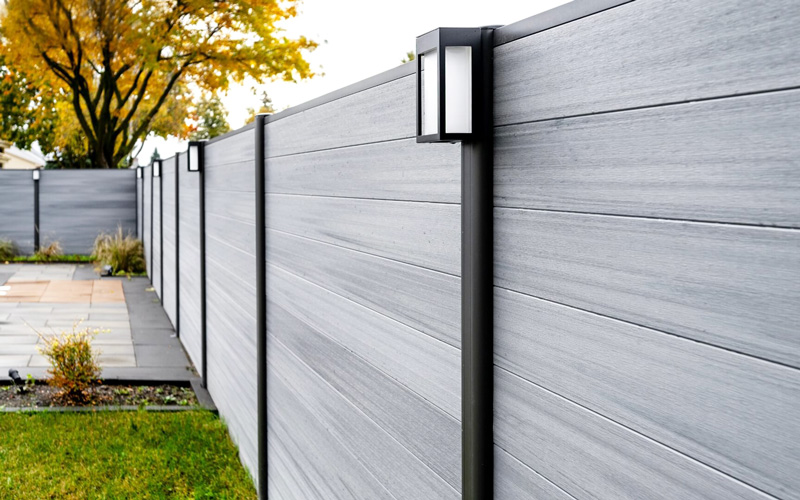
Table of Contents
1. Why 20 mm WPC Fence Boards Matter for Outdoor Fencing
Board thickness is one of the first technical specifications that professional buyers should confirm. For horizontal privacy fencing, 20 mm boards can provide a balance between structural strength, material consumption, appearance, and installation requirements.
However, a stated thickness of 20 mm does not automatically mean that every board will measure exactly 20.0 mm. Manufacturing tolerances should be clearly defined before placing a container order. For example, if a buyer specifically states that boards exceeding 20.0 mm are unacceptable, the supplier should confirm the actual production tolerance and quality-control procedure rather than simply listing “20 mm” in the quotation.
For WPC fence boards, thickness should be considered together with board width, internal structure, wall thickness, weight per linear metre, and recommended unsupported span. These specifications help buyers determine whether the profile is appropriate for their installation system.
A professional quotation should therefore include a cross-section drawing and detailed dimensional information. This makes it easier for the buyer to compare different factories on a like-for-like basis.
2. Tongue-and-Groove Profiles for Horizontal Privacy Fencing
The Polish buyer’s main requirement is a tongue-and-groove board designed for horizontal privacy fencing. This profile is widely used because adjacent boards can connect through an integrated joint, creating a continuous visual surface.
When comparing WPC fence boards, buyers should distinguish between overall board width and effective coverage width. The effective coverage width is particularly important when calculating the actual amount of material required for a fencing project.
For example, if a board has an overall width of 150 mm but the tongue-and-groove connection reduces its effective coverage to 145 mm, the buyer needs to use 145 mm rather than 150 mm when calculating the required linear metres.
The joint design can also influence installation stability, appearance, water drainage, and the finished privacy effect. Manufacturers should provide accurate profile drawings so distributors and installers can understand how the boards connect with each other and with the supporting posts.
For buyers purchasing an entire container, even a small difference in effective coverage can have a significant effect on the total material quantity and final project cost.
3. Mixing Two or Three Colours in One Container
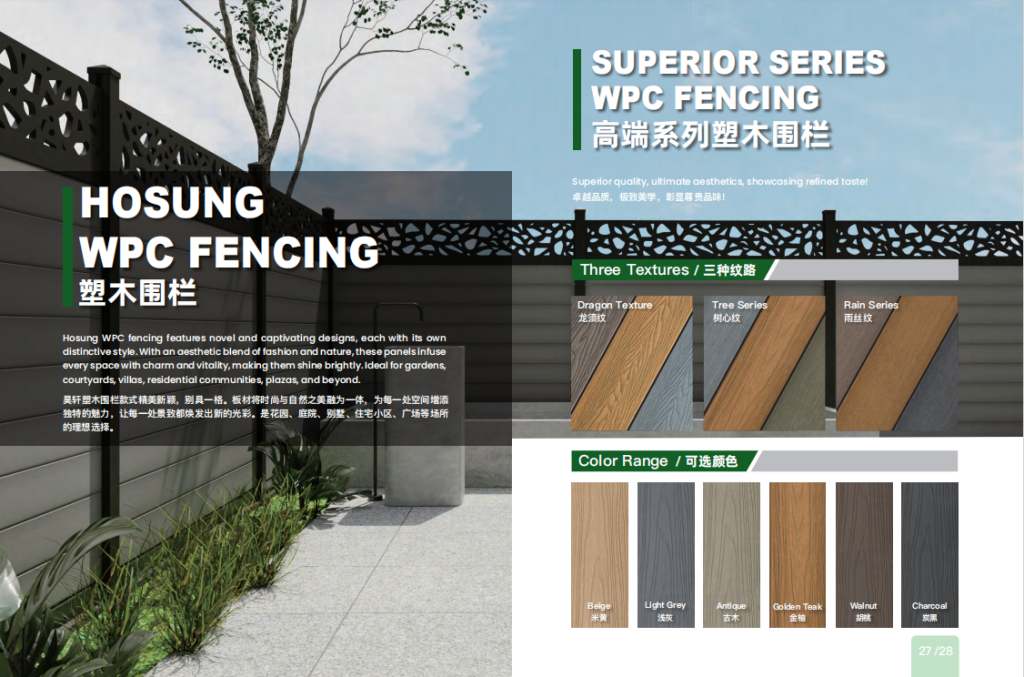
Colour flexibility is another important consideration for European fencing distributors. Instead of purchasing one colour exclusively, a company may want to load two or three standard colours into the same container to serve different customer preferences.
A mixed-colour container can reduce inventory pressure and allow distributors to offer a broader product range without purchasing separate full containers for every colour.
However, buyers should confirm several details before ordering. These include the available standard colours, minimum order quantity per colour, colour consistency between production batches, and whether mixed colours affect the factory price or production schedule.
For outdoor applications, colour stability is especially important. WPC products are exposed to sunlight, rain, temperature changes, and seasonal weather conditions. Therefore, suppliers should be able to provide relevant information about UV resistance and weathering performance.
A colour chart should also be supplied before the order so the buyer can select the exact colours rather than relying only on product names such as grey, brown, or black.
4. Straight-Edge Boards as an Additional Option
Although tongue-and-groove boards may be the main product, some fencing projects require straight-edge boards. These boards can provide greater flexibility for different installation designs, decorative combinations, and project-specific structures.
For this reason, a manufacturer supplying WPC fence boards should ideally offer both tongue-and-groove and straight-edge profiles in a compatible 20 mm thickness.
The buyer should request separate specifications and pricing for the two profiles. Important information includes board dimensions, effective coverage, weight per metre, available lengths, surface texture, colours, and packaging.
Providing different profiles from the same factory can simplify purchasing and logistics. It also allows distributors to develop a more complete fencing product range while maintaining consistent material quality and colour options.
5. Aluminium Posts and Matching Accessories
A WPC fencing system is not complete with boards alone. Aluminium posts, cover strips, finishing trims, and other connection components can significantly influence installation quality and appearance.
For a full-container buyer, it is useful to source the boards and aluminium accessories from the same manufacturer whenever possible. This can simplify product matching, packaging, quality control, and shipment planning.
The supplier should provide technical specifications for each aluminium component, including cross-section dimensions, wall thickness, available colours, surface finish, and applicable board profile.
Surface treatment is particularly important for outdoor aluminium components. Depending on the product, finishes may include powder coating or other treatments designed to improve appearance and durability.
The buyer should also confirm whether aluminium posts and trims can be loaded together with the WPC boards in the same container. Efficient container loading can have a direct impact on the landed cost of a fencing system.
6. FOB Pricing Should Include More Than a Unit Price
When a European buyer requests an FOB quotation, a simple price per board is usually not sufficient for a serious full-container comparison.
A professional quotation should clearly state the named FOB port and provide pricing in several useful units. These may include price per board, price per linear metre, and price per square metre of effective coverage.
This approach allows the buyer to compare suppliers with different board lengths and effective widths.
For example, two factories may offer the same nominal board thickness but different widths or lengths. One supplier may appear cheaper per board while actually having a higher cost per square metre of effective fencing coverage.
The buyer may also request separate pricing for conventional WPC and capped or co-extruded WPC. These products can differ in surface structure, appearance, weathering performance, and manufacturing cost. Comparing them separately helps distributors select the appropriate solution for different market segments.
7. Container Loading Capacity and Packaging
For a full-container order, loading efficiency is a major part of the purchasing decision. A factory should provide loading information for both 20-foot containers and 40-foot high-cube containers when requested.
The quotation should ideally specify the number of boards, total linear metres, effective square metres, net weight, gross weight, and packaging method.
Packaging should protect the boards from scratches, deformation, moisture, and damage during handling and international transportation. The factory should also explain whether boards are packed in bundles, cartons, pallets, or another configuration.
For mixed products, container planning becomes even more important. If WPC boards, aluminium posts, and finishing trims are shipped together, the supplier should confirm how these products are arranged to maximize available space while protecting the goods.
Accurate loading data also helps buyers estimate transportation costs before placing an order.
8. Quality Control for European Outdoor Projects
Price is important in a full-container purchase, but consistent quality is essential for repeat business. A distributor selling fencing products in Poland or Germany needs confidence that subsequent shipments will maintain the same dimensions, colours, profiles, and performance.
Technical documents should therefore cover material composition, board weight, wall thickness, dimensional tolerance, and recommended maximum unsupported span.
Outdoor performance is another important area. Buyers may request test reports related to weathering or UV resistance, water absorption, and dimensional stability. These documents can provide additional information when comparing suppliers.
Independent inspection can also be useful for large orders. If the buyer requests an independent pre-shipment inspection, the manufacturer should clarify whether such an arrangement is permitted and cooperate with the agreed inspection procedure.
This is particularly valuable when the purchase involves a new supplier and a significant container investment.
9. Samples Before a Full-Container Order
Before committing to a full container, professional fencing companies should evaluate physical samples. Samples allow buyers to inspect the actual colour, surface texture, board thickness, tongue-and-groove connection, rigidity, and dimensional accuracy.
For a mixed-colour order, samples can also help confirm whether the colours match the buyer’s market expectations.
It is advisable to request samples of both the main tongue-and-groove board and any straight-edge option, as well as representative aluminium posts and trims. The supplier should provide clear information about sample availability, shipping arrangements, and whether sample costs can be credited against a subsequent bulk order.
A sample evaluation can identify potential problems before mass production begins, reducing the risk associated with a large first shipment.
10. Factory Capability and Long-Term Supply
A company looking for repeat orders should evaluate more than the product itself. Factory capability, production consistency, quality management, and export experience are all relevant.
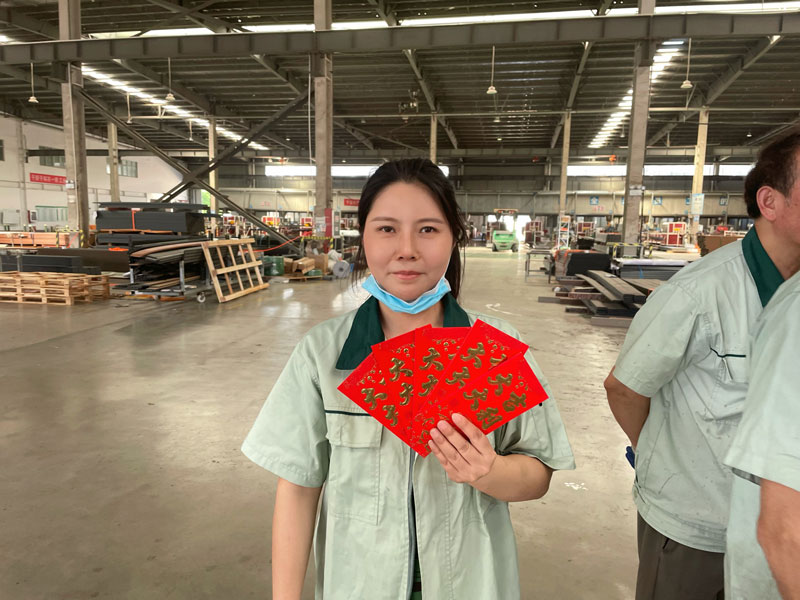
Buyers may ask whether the supplier manufactures the boards in its own factory or purchases them from another source. A registered company name and factory address can help verify the supply chain.
For larger European customers, a recent independent factory audit report can provide additional confidence regarding production conditions and quality-management processes. References from existing European customers may also help buyers understand the supplier’s experience with similar markets.
Production lead time, payment terms, quotation validity, and warranty conditions should be confirmed before the purchase order is issued.
11. What Makes a Competitive WPC Fence Board Supplier?
For a Polish fencing distributor, the most competitive supplier is not necessarily the factory offering the lowest unit price. The better choice is often the supplier that provides the best combination of price, dimensional consistency, production capacity, technical support, packaging efficiency, and reliable delivery.
A suitable manufacturer should be able to provide 20 mm tongue-and-groove profiles within the required tolerance, multiple standard colours, straight-edge alternatives, compatible aluminium accessories, clear technical drawings, container loading data, and appropriate outdoor-performance documentation.
The supplier should also be prepared to support sample evaluation and independent pre-shipment inspection when required.
For full-container purchasing, these details make the difference between a simple quotation and a professional sourcing proposal.
Final Thoughts
Conclusion
The sourcing requirements of a Polish fencing company demonstrate how European buyers evaluate WPC fence boards from Hosung WPC for full-container procurement. The focus extends beyond the nominal board price to include exact 20 mm thickness control, tongue-and-groove construction, effective coverage width, colour mixing, straight-edge alternatives, aluminium accessories, FOB pricing, container capacity, packaging, technical documentation, samples, testing, and inspection.
For manufacturers, providing complete and transparent information from the beginning can make quotation comparison easier and build confidence with professional distributors. For buyers, evaluating these factors before placing a full-container order can reduce purchasing risks and create a stronger foundation for repeat cooperation.
A well-matched WPC fencing supplier should therefore be able to combine competitive factory pricing with stable production, accurate specifications, flexible colour options, complete accessories, efficient loading, and dependable quality control for the European outdoor fencing market.