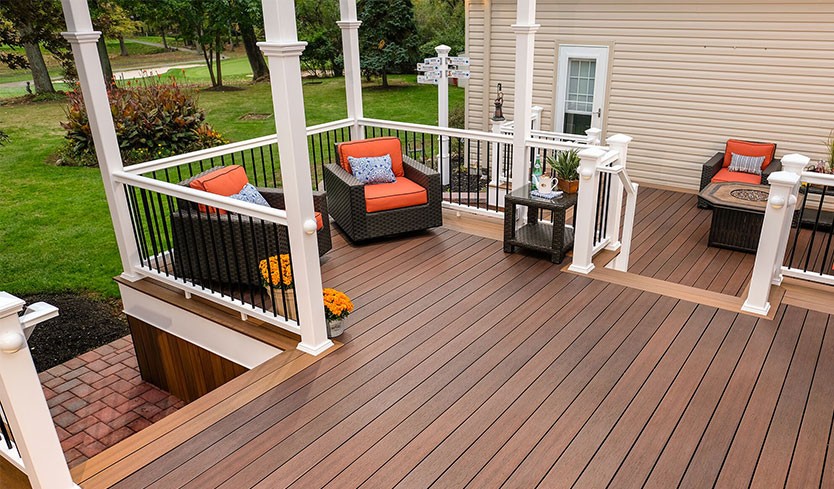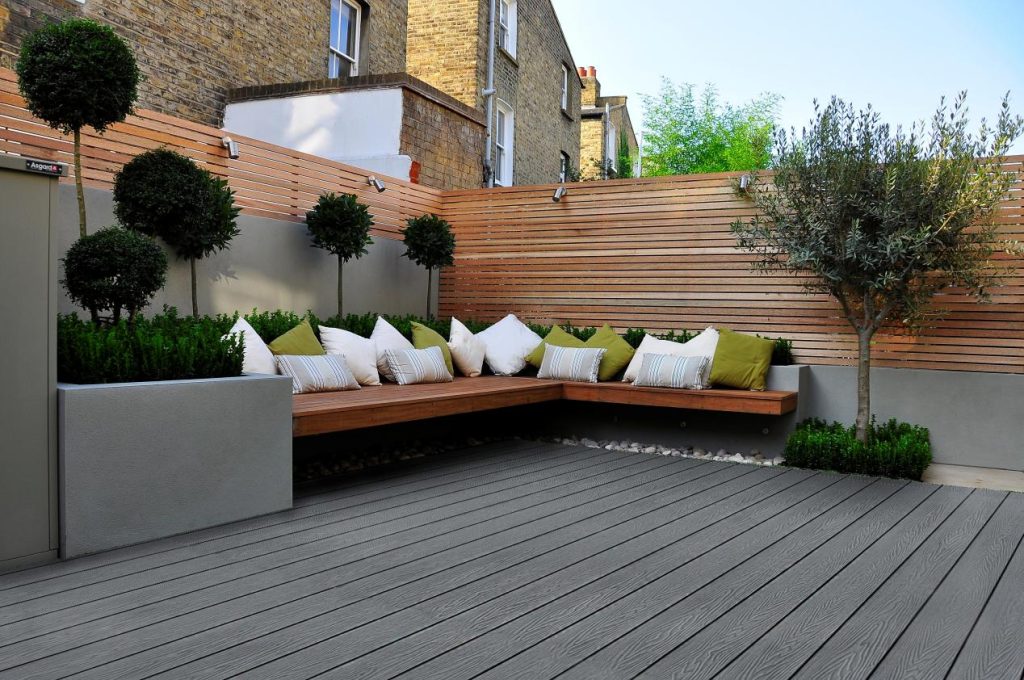
Understanding dimensions of composite decking is essential for anyone planning a durable, visually appealing, and structurally sound outdoor deck. Whether you are a contractor, architect, or homeowner, knowing the standard sizing, variations, and how these measurements impact installation can help you make better material choices and avoid costly mistakes. The dimensions of composite decking are not just about length and width—they also include thickness, profile type, board structure, and even installation spacing requirements. These factors collectively determine performance, load capacity, appearance, and long-term maintenance needs. In this guide, we will break down everything you need to know about the dimensions of composite decking, including standard sizes, variations across manufacturers, and how to choose the right option for your project.
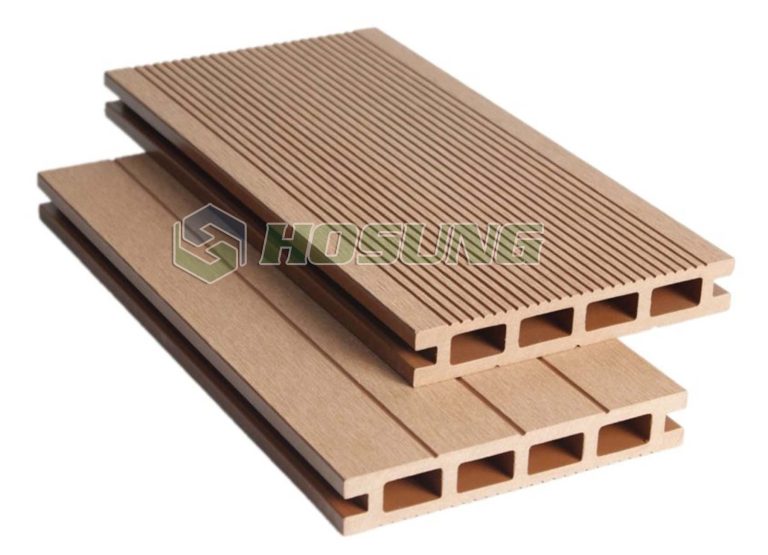
Table of Contents
Standard Dimensions of Composite Decking Boards
Most composite decking products follow industry-standard sizing, although exact measurements can vary by brand and region.
1. Width of Composite Decking
The most common width ranges are:
- 120mm (4.7 inches)
- 140mm (5.5 inches)
- 150mm (5.9 inches)
- 160mm (6.3 inches)
- 200mm (7.9 inches)
Wider boards are often used for modern, luxury designs, while narrower boards provide a more traditional wood-like appearance.
The width is one of the most noticeable aspects when discussing dimensions of composite decking, as it directly affects visual style and installation pattern.
2. Thickness of Composite Decking
Thickness typically ranges from:
- 20mm (standard residential decking)
- 23mm (reinforced structural boards)
- 25–30mm (heavy-duty commercial applications)
Thicker boards usually offer:
- Higher load-bearing capacity
- Better resistance to warping
- Improved durability for high-traffic areas
When evaluating dimensions of composite decking, thickness is one of the most important structural factors.
3. Length of Composite Decking
Standard lengths include:
- 2.2 meters (7.2 ft)
- 2.7 meters (8.9 ft)
- 3.6 meters (11.8 ft)
- 4.8 meters (15.7 ft)
- 5.4 meters (17.7 ft)
- Custom lengths up to 6 meters or more
Longer boards reduce the number of joints, creating a cleaner aesthetic, but may require more careful handling during installation.
The length is another key factor in dimensions of composite decking, especially for large outdoor spaces where seamless appearance matters.
Profile Types and How They Affect Dimensions
Composite decking boards are not all manufactured with the same internal structure. While the external dimensions of composite decking may look identical across different products, the internal profile design plays a major role in performance, installation requirements, weight, and long-term durability. Understanding these differences is essential when selecting materials for residential, commercial, or public construction projects.
Below are the two primary structural types used in composite decking production: solid boards and hollow boards.
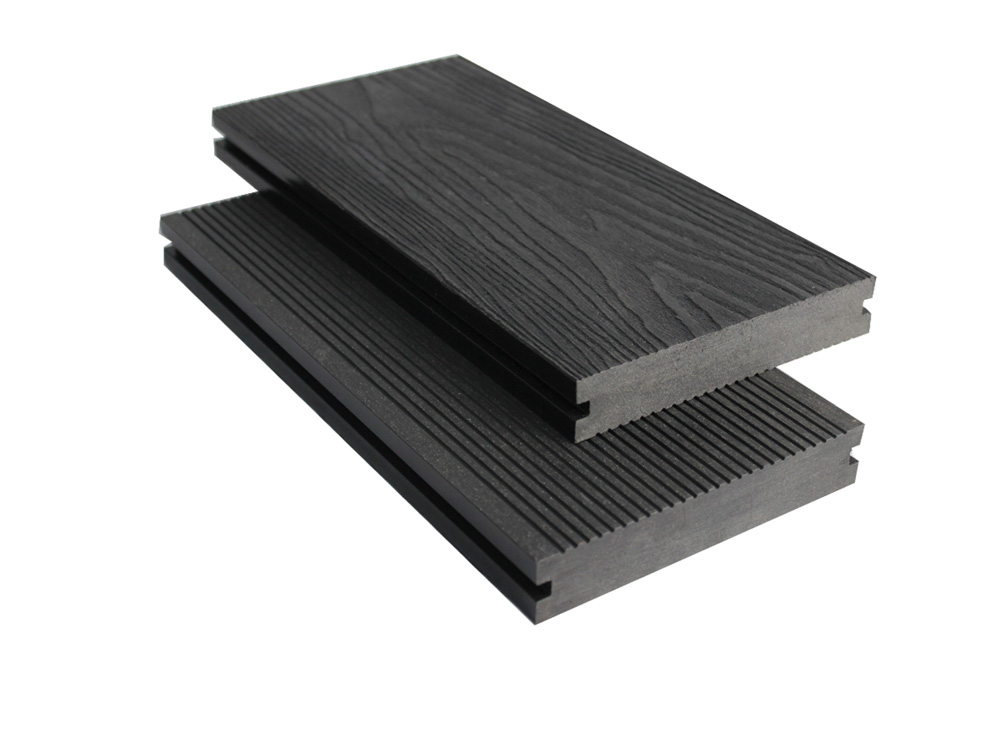
1. Solid Composite Decking
Solid composite decking is manufactured with a fully dense internal structure, meaning the board has no internal voids or cavities. The material composition is consistent from surface to core, which gives it a more traditional lumber-like feel while offering enhanced durability.
Key Structural Features
- Fully dense internal composition
- Uniform material distribution throughout the board
- No internal air gaps or hollow channels
- Heavier per linear meter compared to hollow profiles
Performance Advantages
1. Higher Strength and Load Capacity
Solid boards generally provide superior structural strength. Because there are no hollow sections, the load is distributed evenly across the entire cross-section. This makes them suitable for high-traffic or heavy-load environments such as commercial walkways, public terraces, and outdoor seating areas.
2. Improved Impact Resistance
The dense structure reduces the risk of cracking, splitting, or surface indentation. This is especially important in environments where furniture movement, foot traffic, or falling objects are common.
3. Easier Cutting and Fabrication
Solid composite decking is easier to cut into custom shapes or lengths without worrying about exposing internal cavities. This simplifies installation for complex layouts or irregular project designs.
4. Better Fastener Holding Power
Screws and hidden fasteners tend to grip more securely in solid material. This reduces the risk of loosening over time, especially in climates with temperature fluctuations.
Considerations
- Heavier Weight: Increases transportation cost and may require more labor during installation
- Higher Material Cost: More raw material is used in production
- Thermal Expansion: Like all composites, solid boards still expand and contract with temperature changes, but mass can slightly influence movement behavior
Typical Applications
- Luxury residential decking
- High-traffic commercial areas
- Public boardwalk systems
- Outdoor restaurants and cafes
- Rooftop terraces with heavy furniture loads
2. Hollow Composite Decking
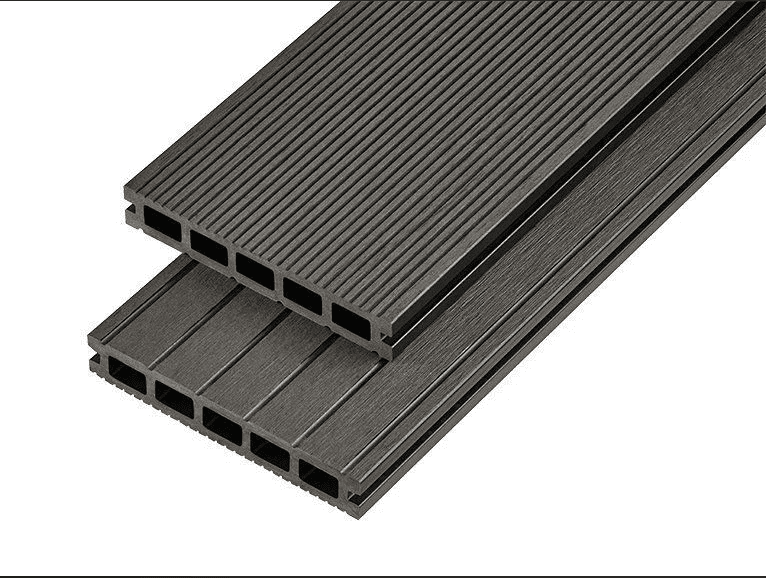
Hollow composite decking features internal channels or voids running along the length of the board. These cavities are designed to reduce material usage while maintaining acceptable strength for many standard applications.
Key Structural Features
- Internal hollow chambers or grid-like channels
- Reduced material density
- Lightweight structure
- Often paired with capped exterior layers for protection
Performance Advantages
1. Lightweight Handling and Transport
One of the most significant advantages of hollow boards is reduced weight. This makes them easier to carry, lift, and install, especially in large-scale projects where labor efficiency is important.
2. Cost Efficiency
Because less raw material is used in production, hollow composite decking is generally more affordable. This makes it attractive for budget-sensitive projects without sacrificing basic performance requirements.
3. Faster Installation
Reduced weight allows installers to work more quickly, especially on elevated or difficult-to-access surfaces such as balconies or rooftops.
4. Sufficient Performance for Residential Use
For standard residential decks with moderate foot traffic, hollow boards often provide more than enough structural performance when properly installed with correct joist spacing.
Important Limitations
1. Lower Impact Resistance
Hollow sections are more vulnerable to localized damage. Heavy impacts or concentrated loads may cause deformation or cracking in thin-walled areas.
2. Edge Protection Requirements
The exposed ends of hollow boards must be capped or sealed. Without protection, moisture, dirt, or insects may enter the internal cavities, potentially affecting long-term durability.
3. Reduced Fastener Flexibility
Fastener placement must be carefully planned. Improper screw placement near hollow sections can reduce holding strength or damage the internal structure.
4. Limited Load-Bearing Applications
Hollow decking is not ideal for high-load commercial environments unless specifically engineered with reinforced walls.
Typical Applications
- Residential backyard decks
- Balcony flooring systems
- Light-use garden pathways
- Temporary or modular outdoor platforms
- Budget-focused landscaping projects
3. Dimensional Impact of Internal Structure
Even when two composite decking boards share the same external measurements—such as width, thickness, and length—their internal structure significantly affects real-world performance and usability.
Weight Differences
- Solid boards are significantly heavier due to full material density
- Hollow boards can be 10%–40% lighter depending on design
- Weight influences shipping cost, handling, and structural load calculations
Effective Strength vs. Nominal Size
External dimensions do not fully represent structural capacity. A 140mm × 25mm solid board will behave very differently from a hollow board of identical size under load conditions.
Thermal Expansion Behavior
Internal structure can slightly influence expansion rates:
- Solid boards: more stable due to mass distribution
- Hollow boards: may respond more quickly to temperature changes
Installation Spacing Requirements
Joist spacing often varies depending on profile type:
- Solid boards: can allow wider spacing in some systems
- Hollow boards: usually require tighter support spacing to prevent flexing
4. Selection Considerations for Projects
Choosing between solid and hollow composite decking should be based on project requirements rather than appearance alone.
Choose Solid Boards When:
- Structural strength is a priority
- The area will experience heavy foot traffic
- Long-term durability is critical
- Complex cutting and shaping is required
- Premium appearance and stability are desired
Choose Hollow Boards When:
- Budget efficiency is important
- Weight reduction is needed for installation
- The project is residential or low-traffic
- Fast installation is a priority
- Structural demands are moderate
Capped vs Uncapped Boards and Dimensional Stability
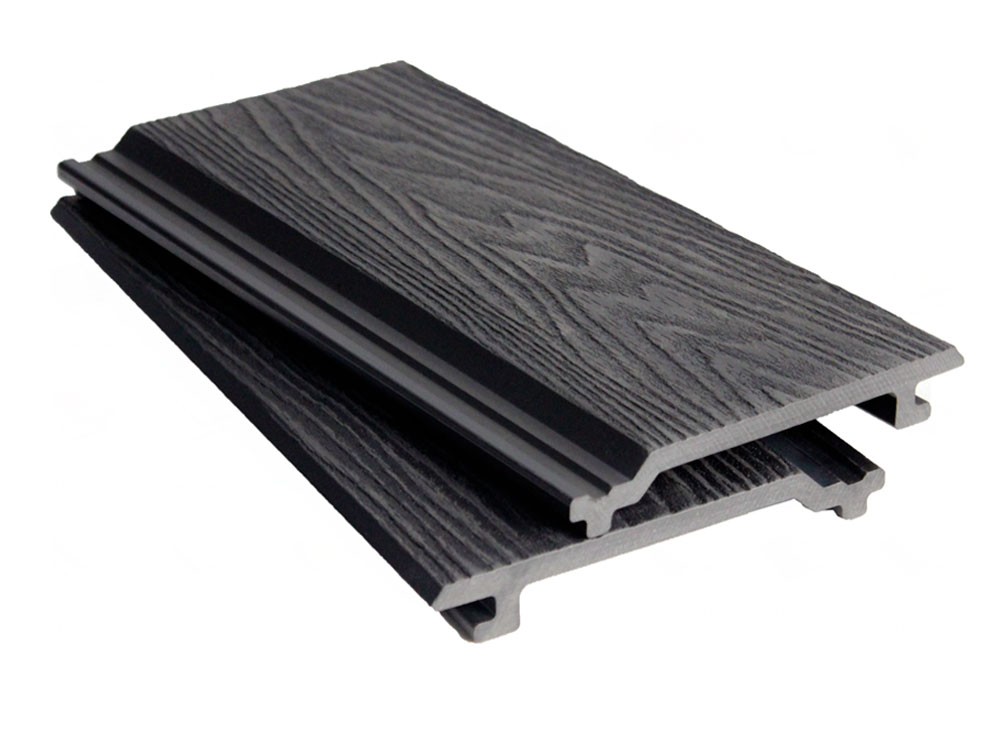
Capped composite decking has a protective polymer shell, while uncapped boards do not.
Capped Boards
- Better moisture resistance
- Improved UV stability
- More consistent long-term dimensions of composite decking
Uncapped Boards
- Slightly more natural appearance
- More prone to fading and minor expansion
Dimensional stability is critical because outdoor materials expand and contract due to temperature and humidity changes.
How Dimensions of Composite Decking Affect Installation
Choosing the right dimensions of composite decking directly impacts installation efficiency and structural safety.
1. Joist Spacing Requirements
Typical joist spacing depends on board thickness:
- 20mm boards → 300mm–350mm spacing
- 23mm boards → 400mm spacing
- Heavy-duty boards → up to 500mm spacing
Incorrect spacing can lead to sagging or surface deformation.
2. Expansion Gaps
Composite materials expand slightly with heat, so installers must leave gaps:
- Side gaps: 3–6mm
- End-to-end gaps: 5–10mm
These tolerances are part of the practical application of dimensions of composite decking, ensuring long-term performance.
3. Fastening Systems
Hidden clips and screw systems are designed based on standard board sizes. If dimensions of composite decking vary too much from standard specs, compatibility issues may arise.
Comparing Composite Decking Dimensions with Wood Decking
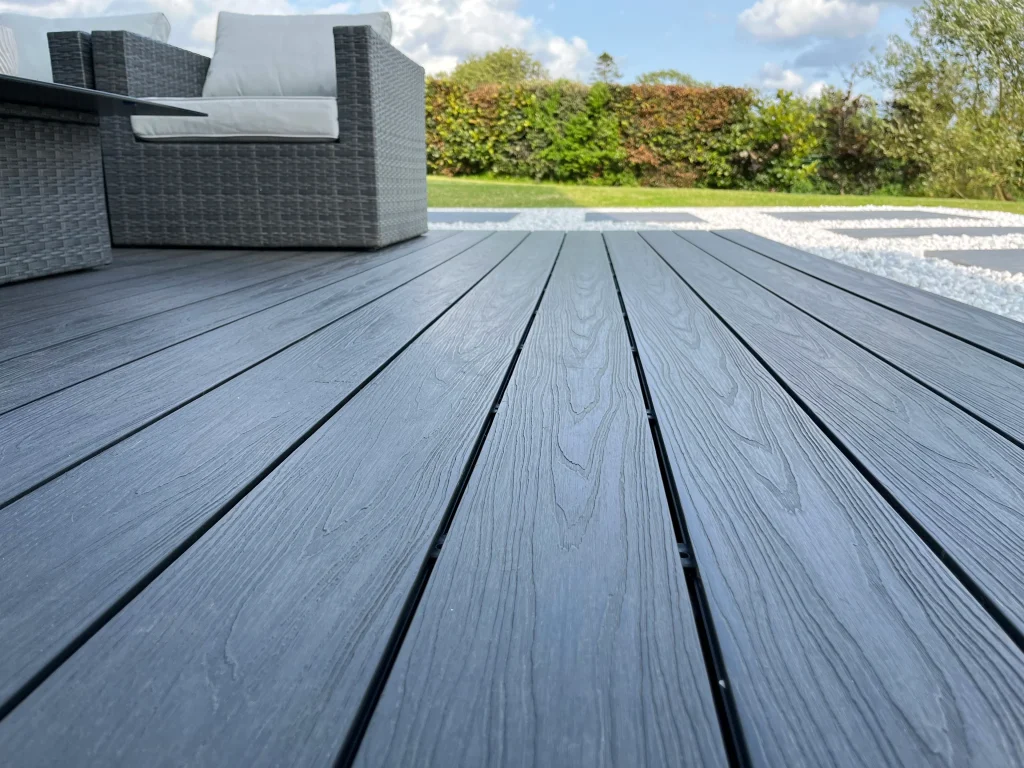
When comparing materials, the dimensions of composite decking differ slightly from natural wood.
Wood Decking
- More variation due to natural material inconsistencies
- Can shrink or swell significantly
- Requires frequent maintenance adjustments
Composite Decking
- Factory-controlled sizing
- More stable dimensions of composite decking
- Minimal deformation over time
This consistency is one of the biggest advantages of composite materials.
Regional Differences in Composite Decking Dimensions
Different markets may adopt slightly different sizing standards.
North America
- Common width: 140mm–150mm
- Thickness: around 25mm
- Focus on structural strength
Europe
- More variety in width (120mm–200mm)
- Slimmer profile options available
- Emphasis on aesthetics
Asia
- Wide range of economical options
- Lightweight hollow boards more common
- Flexible dimensions of composite decking for cost efficiency
These regional differences allow manufacturers to meet diverse construction needs.
Structural Impact of Dimensions
The dimensions of composite decking directly influence structural performance.
Load Capacity
- Thicker boards = higher load resistance
- Narrower boards = more flexible but less load-bearing
Span Capability
- Wider joist spacing possible with thicker boards
- Shorter spans needed for thinner boards
Stability
Proper sizing ensures minimal bending, especially in high-temperature environments.
Aesthetic Considerations
The appearance of a deck is heavily influenced by dimensions of composite decking.
Wide Boards
- Modern, luxury appearance
- Fewer seams
- Faster installation
Narrow Boards
- Traditional wood-like appearance
- More detailed visual texture
- Suitable for small spaces
The choice of dimensions can completely change the visual identity of an outdoor space.
Weight and Handling Factors
Another important aspect of dimensions of composite decking is weight.
- Wider and thicker boards are heavier
- Hollow boards are significantly lighter
- Longer boards require mechanical handling in large projects
Weight affects transportation, labor costs, and installation speed.
Commercial vs Residential Applications
Different applications require different dimensions of composite decking.
Residential Decking
- 20–23mm thickness
- Medium width boards
- Focus on comfort and design
Commercial Decking
- 25–30mm thickness
- Reinforced structures
- Designed for heavy foot traffic
Public Infrastructure
- Custom oversized profiles
- Anti-slip surface treatments
- Maximum durability requirements
How to Choose the Right Dimensions
Selecting the correct dimensions of composite decking depends on several factors:
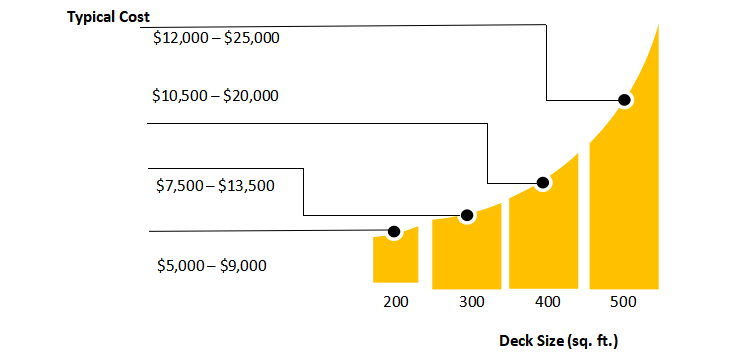
1. Project Size
- Small patios → narrower boards
- Large terraces → wider boards
2. Load Requirements
- Light use → standard thickness
- Heavy traffic → reinforced boards
3. Climate Conditions
- Hot climates → more expansion allowance needed
- Cold climates → focus on stability and freeze resistance
4. Design Preference
- Modern style → wide, long boards
- Classic style → narrow, medium-length boards
Future Trends in Composite Decking Dimensions
The industry is evolving, and dimensions of composite decking are also changing.
Trend 1: Ultra-Wide Boards
- Cleaner aesthetics
- Faster installation
- Premium market demand
Trend 2: Ultra-Thin Profiles
- Lightweight construction
- Easy installation systems
- Suitable for balconies and rooftops
Trend 3: Custom Modular Sizes
- Project-specific manufacturing
- Reduced material waste
- Flexible design options
These innovations are expanding the possibilities of outdoor design.
FAQs About Composite Decking Dimensions
1. Are all composite decking boards the same size?
No, dimensions of composite decking vary depending on brand, region, and application.
2. What is the most common size?
The most common dimensions of composite decking are around 140–150mm width and 20–25mm thickness.
3. Can composite decking be cut?
Yes, boards can be trimmed to fit custom layouts without affecting performance.
4. Do dimensions change over time?
Minimal changes occur, but high-quality boards maintain stable dimensions of composite decking throughout their lifespan.
Conclusion
The dimensions of composite decking play a crucial role in performance, aesthetics, and installation success. From width and thickness to length and structural design, every measurement influences how the decking performs in real-world conditions.
By understanding standard sizing from Hosung, regional variations, and installation requirements, you can choose the most suitable option for your project. Whether for residential patios or large commercial spaces, selecting the right dimensions of composite decking ensures durability, stability, and long-term visual appeal.