Composite decking has become a dominant material in modern outdoor construction due to its durability, low maintenance requirements, and aesthetic versatility. Among the most debated choices within this category is whether hollow or solid composite decking performs better in real-world applications. Both options are engineered from a blend of wood fibers and recycled plastics, yet their internal structures create significant differences in strength, cost, installation, lifespan, and overall performance. This article provides a comprehensive, engineering-level comparison of hollow and solid composite decking across structural behavior, environmental performance, installation complexity, lifecycle cost, and application suitability.
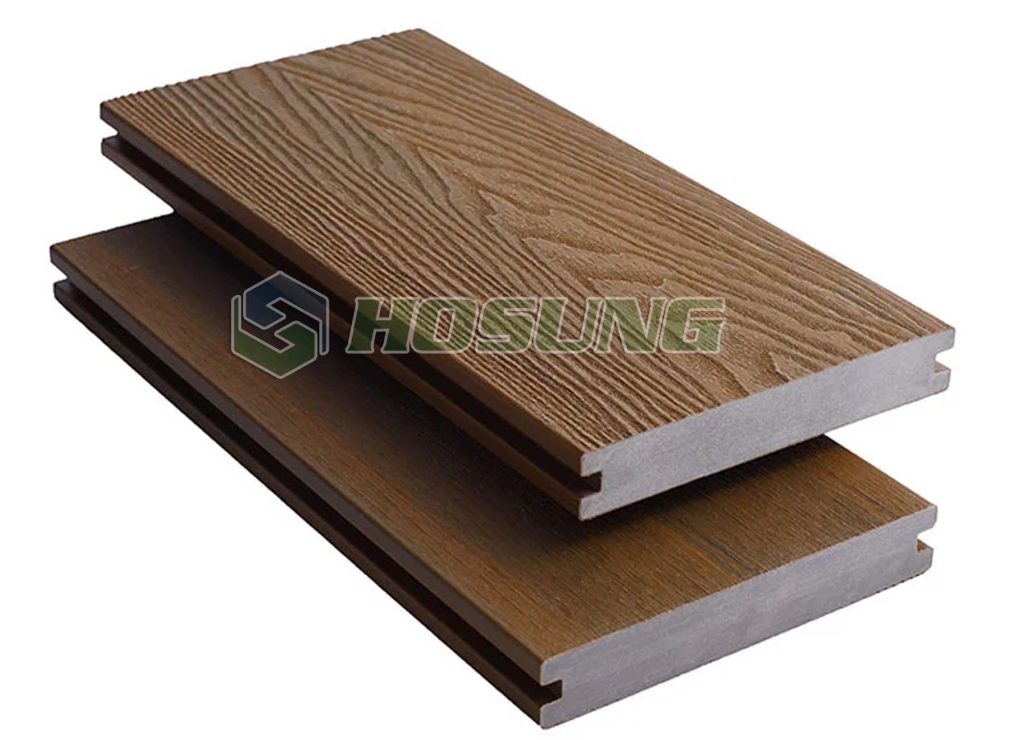
Table of Contents
Understanding Composite Decking Structures
Composite decking boards are generally manufactured using two primary structural configurations:
Hollow Composite Decking
Hollow boards contain internal voids or channels running longitudinally through the profile. These cavities reduce material usage while maintaining an outer structural shell.
Key structural characteristics:
- Internal hollow chambers (round, square, or honeycomb)
- Reduced weight per linear meter
- Thinner wall thickness compared to solid boards
- Often reinforced with ribs or internal webs
Solid Composite Decking
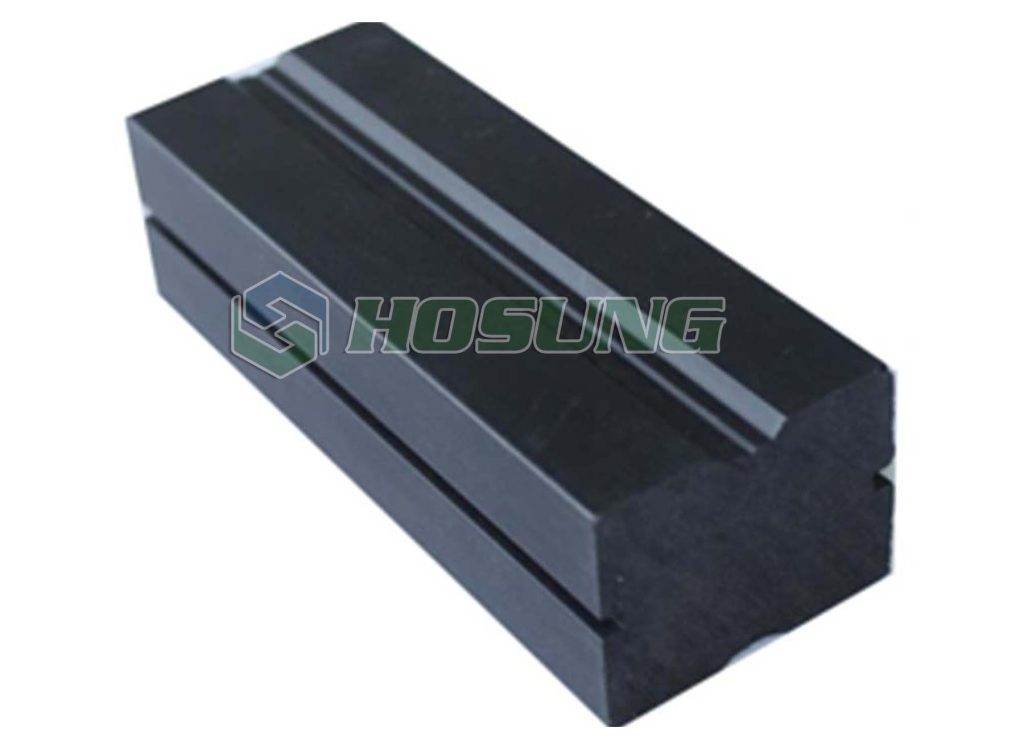
Solid boards are fully filled composite profiles without internal voids. The material is uniform throughout the cross-section.
Key structural characteristics:
- Fully dense internal structure
- Higher mass and weight
- Uniform load distribution
- Greater machining and fastening flexibility
Both types are manufactured using extrusion technology, but the mold design and material density differ significantly.
Structural Performance Comparison
Load-Bearing Capacity
Solid composite decking generally offers superior load-bearing performance due to its continuous material density. The absence of internal voids allows stresses to distribute evenly across the board.
Advantages of solid decking:
- Higher point-load resistance
- Better performance under concentrated weight (furniture, hot tubs, planters)
- Reduced risk of structural deformation over time
Hollow decking, while engineered with internal ribs for reinforcement, tends to perform better under distributed loads rather than concentrated pressure. Excessive point loading may cause localized deformation if not properly supported.
Flexural Strength and Deflection
Deflection is a critical parameter in decking design. Solid boards typically exhibit lower deflection under identical span conditions.
- Solid boards: Higher stiffness modulus
- Hollow boards: Improved stiffness-to-weight ratio but slightly higher deflection under long spans
For residential applications with closely spaced joists, hollow decking performs adequately. However, for commercial or high-traffic environments, solid decking provides better long-term rigidity.
Impact Resistance
Impact resistance refers to how well the decking withstands sudden force.
- Solid composite decking: Excellent resistance to dropped objects and heavy impact
- Hollow composite decking: Moderate resistance, but internal voids may concentrate stress
In environments such as rooftop decks or public walkways, solid boards are generally preferred due to higher durability under unpredictable loading conditions.
Weight and Handling Efficiency
Hollow Decking Advantages
One of the most significant benefits of hollow composite decking is reduced weight.
Key advantages:
- Easier transportation and logistics
- Lower structural load on subframes
- Faster installation due to lighter handling
- Reduced shipping cost per square meter
This makes hollow decking particularly suitable for:
- DIY installations
- Elevated decks
- Projects with limited structural support capacity
Solid Decking Considerations
Solid boards are heavier, which increases both advantages and disadvantages:
Benefits:
- Greater stability during installation
- Reduced vibration underfoot
- Premium “solid wood” feel
Limitations:
- More labor-intensive handling
- Higher transportation costs
- Increased structural load requirements
In large-scale commercial projects, the additional weight may also require reinforced framing systems.
Durability and Longevity
Moisture Resistance
Both hollow and solid composite decking are designed to resist moisture, but structural differences influence long-term performance.
Solid decking:
- Lower risk of internal moisture accumulation
- No hollow cavities for water entrapment
- Better long-term dimensional stability
Hollow decking:
- Properly sealed designs prevent water ingress
- Poor-quality boards may allow moisture accumulation in cavities
- Risk of internal condensation in extreme climates
In high-humidity or freeze-thaw regions, solid decking generally performs more consistently over time.
Resistance to Rot, Mold, and Insects
Composite materials are inherently resistant to biological degradation. However:
- Solid boards: Lower internal vulnerability due to uniform structure
- Hollow boards: If compromised, internal cavities may become difficult to dry or clean
Proper manufacturing quality is essential for both types.
UV and Weathering Performance
Both hollow and solid decking typically include UV stabilizers and protective polymer coatings.
Performance factors:
- Solid boards maintain color consistency longer due to higher pigment density
- Hollow boards may experience slight surface fading differences if wall thickness varies
In long-term exposure environments, solid decking tends to age more uniformly.
Thermal Expansion and Climate Behavior
Composite decking expands and contracts with temperature fluctuations.
Hollow Decking Behavior
- Faster thermal response due to reduced mass
- Slightly higher expansion rates in some designs
- Requires careful spacing during installation
Solid Decking Behavior
- More thermally stable due to greater material volume
- Slower heat absorption and dissipation
- More predictable dimensional movement
In extreme climates (hot summers or freezing winters), solid decking provides more consistent performance.
Installation Considerations
Ease of Installation
Hollow decking:
- Easier to cut and handle
- Lower physical strain during installation
- Often compatible with clip-based hidden fastening systems
Solid decking:
- Requires more effort to cut and drill
- Heavier handling during installation
- Greater flexibility for fastening options
Fastening Systems
Both decking types support:
- Hidden clip systems
- Face screwing
- Edge fastening (depending on profile design)
However:
- Solid boards allow more aggressive fastening without risk of structural compromise
- Hollow boards require precision to avoid damaging internal cavities
Spacing and Subframe Requirements
Hollow decking generally requires:
- Closer joist spacing
- More precise alignment of support structures
Solid decking allows:
- Wider joist spacing
- Greater tolerance for subframe imperfections
Cost Analysis and Economic Efficiency
A deeper economic evaluation of hollow and solid composite decking requires looking beyond upfront pricing and considering the full lifecycle cost model, which includes material procurement, installation labor, structural requirements, maintenance frequency, and long-term replacement risk. In engineered outdoor systems, the true cost of ownership is rarely determined by purchase price alone, but rather by how the material performs under sustained environmental and mechanical stress.
Material Cost Dynamics
The price difference between hollow and solid composite decking is primarily driven by raw material consumption and extrusion density. Hollow boards use a reduced volume of wood-plastic composite (WPC) material due to internal voids, which directly lowers resin and wood fiber input per linear meter. This structural efficiency typically results in a 10%–30% lower unit cost compared to solid profiles.
However, this apparent saving must be contextualized within manufacturing complexity. Hollow profiles require more precise extrusion molds, internal rib reinforcement design, and tighter quality control to ensure uniform wall thickness. In lower-grade products, cost savings may be offset by increased defect rates or inconsistent structural integrity, especially in high-temperature extrusion environments.
Solid composite decking, by contrast, consumes a full cross-sectional volume of composite material. This increases polymer and filler usage significantly, resulting in higher production costs per board. Yet this also provides greater consistency in mechanical performance, reducing variability across batches, which can be a hidden economic advantage in large-scale procurement projects where uniformity is critical.
Installation Cost Structure
Installation cost is a major component of total project expenditure, often accounting for 40%–60% of total decking system cost when subframe preparation and labor are included.
Hollow decking reduces installation costs in several indirect ways:
- Lower board weight decreases manual handling effort and reduces crew fatigue
- Faster positioning and alignment improves installation throughput per day
- Reduced load on supporting structures may eliminate the need for additional reinforcement in light-duty applications
- Lower shipping weight decreases logistics and on-site handling costs
In contrast, solid decking introduces higher installation expenditure due to increased material density. Heavier boards require more labor per square meter installed, especially in elevated or multi-level structures. Cutting and fastening operations also demand more robust tools and sometimes additional manpower to ensure precision alignment.
However, solid decking can reduce installation risk in certain scenarios. Its higher structural rigidity allows installers to work with slightly wider tolerances in subframe alignment, potentially reducing the need for micro-adjustments or rework. In large commercial installations, this can partially offset labor inefficiencies by minimizing corrective work during final inspection.
Long-Term Maintenance and Lifecycle Economics
From a lifecycle cost perspective, both hollow and solid composite decking outperform traditional timber due to their resistance to rot, insect infestation, and moisture degradation. However, differences emerge when evaluating long-term structural resilience and repair probability.
Solid decking generally demonstrates lower lifecycle maintenance cost in high-traffic or high-load environments. Its uniform density reduces the likelihood of localized failure, cracking, or internal stress concentration. As a result, replacement cycles are extended, and the probability of spot repairs is significantly reduced. Over a 15–25 year service life, this can translate into a lower total cost of ownership despite higher initial investment.
Hollow decking, while cost-effective upfront, may incur additional maintenance considerations in demanding applications. If structural damage occurs—particularly from concentrated loads or improper subframe spacing—repairs are often more localized but potentially more complex due to internal cavity constraints. In some cases, entire board replacement may be required even for partial damage, which increases long-term maintenance expenditure.
Nevertheless, in residential or light-duty applications, hollow decking remains economically efficient. When properly installed within recommended span limits and load conditions, its maintenance profile remains minimal, and cost advantages over time can be significant.
Lifecycle Cost Optimization Perspective
When evaluated under a lifecycle costing (LCC) model, solid composite decking often achieves superior economic performance in environments characterized by:
- High pedestrian traffic
- Heavy static loads (furniture, equipment, landscaping features)
- Long design life expectations (20+ years)
- Commercial or public infrastructure usage
Hollow composite decking, however, demonstrates optimal cost efficiency in:
- Residential outdoor living spaces
- Low to moderate traffic areas
- Budget-sensitive construction projects
- Structures where weight reduction provides secondary structural savings
Ultimately, the economic decision should be based on total cost of ownership rather than unit price alone, integrating material efficiency, installation labor, structural engineering requirements, and expected service life into a single comparative framework.
Aesthetic and Design Considerations
Surface Appearance
Both hollow and solid boards can feature:
- Wood grain embossing
- Brushed finishes
- Multi-tone color blending
However:
- Solid decking often provides a more “premium” visual depth
- Hollow decking may feel slightly lighter underfoot depending on thickness
Edge and Profile Visibility
Hollow boards may expose internal cavities at cut edges unless capped or trimmed.
Solid boards:
- Maintain consistent appearance even at exposed edges
- Preferred for visible perimeter installations
Design Flexibility
Hollow decking:
- Better suited for modular or lightweight structures
- Common in temporary or semi-permanent installations
Solid decking:
- Preferred for architectural-grade outdoor design
- Better integration with high-end landscaping projects
Environmental and Sustainability Factors
Material Efficiency
Hollow decking uses less raw material per board, making it:
- More resource-efficient
- Lower in production energy consumption
Solid decking uses:
- More composite material
- Higher embodied energy per unit
Recyclability
Both types are typically made from recycled plastics and wood fibers. At end-of-life:
- Both can be reprocessed depending on local recycling infrastructure
Lifecycle Sustainability
While hollow decking has lower initial environmental impact, solid decking may:
- Last longer in demanding environments
- Reduce replacement frequency
Sustainability outcome depends on application context.
Safety Performance
Slip Resistance
Both hollow and solid decking can be engineered with anti-slip surfaces.
Solid decking:
- More consistent traction under varying loads
Hollow decking:
- Slight variation in vibration response depending on subframe
Fire Resistance
Performance depends on additives rather than structure, but:
- Solid boards may exhibit slightly slower burn-through due to density
- Hollow boards can allow faster internal flame propagation if compromised
Always verify fire rating compliance for building codes.
Application-Based Recommendations
Best Use Cases for Hollow Composite Decking
Hollow decking is ideal for:
- Residential balconies
- DIY backyard decks
- Light pedestrian traffic areas
- Elevated structures where weight reduction is critical
- Budget-sensitive projects
Best Use Cases for Solid Composite Decking
Solid decking is preferred for:
- Commercial boardwalks
- Public infrastructure
- High-traffic outdoor areas
- Rooftop terraces with heavy furniture
- Luxury landscaping projects
- Long-span installations
Final Verdict: Which Is Better?
There is no universal winner between hollow and solid composite decking. The optimal choice depends on engineering requirements, budget constraints, and environmental conditions.
Hollow Composite Decking is better when:
- Weight reduction is a priority
- Budget constraints are strict
- Installation speed is important
- Loads are moderate and evenly distributed
Solid Composite Decking is better when:
- Maximum durability is required
- High traffic or heavy loads are expected
- Long-term performance is critical
- Structural rigidity is a priority
Conclusion
The decision between hollow and solid composite decking should be based on performance engineering rather than cost alone. Hollow boards offer efficiency, ease of installation, and reduced structural load, making them suitable for residential and lightweight applications. Solid boards deliver superior strength, stability, and longevity, making them the preferred choice for demanding environments and long-term infrastructure.
A well-designed decking system often balances material selection with joist spacing, fastening method, and environmental exposure conditions. Understanding these technical trade-offs ensures optimal performance, safety, and return on investment over the lifecycle of the deck.